Kinross-shire is a small county measuring, barely 15 miles from west to east 9 miles from north to south. Ringed with hills, the Lomonds to the east, the Ochils to the west and Benarty Hill to the south ensure pleasing views and plenty of opportunity for hill walking.
Under the Local Government Act of 1973, Kinross-shire became, in 1975, part of Tayside region. In 1996 there was another local government re-organisation, Tayside was dissolved and Kinross-shire became part of Perth & Kinross District.
 Balado is a relatively new settlement, up until twenty years ago there was no village, simply a collection of farms. Easily identifiable by the NATO Communications Facility or the “Golfball” which has now been closed.
The ex World War II airfield has now become home to Balado Airfield, There are lots of ways to get airborne at Balado. From first time flight experiences taking in incredible views across Loch Leven, the Forth Bridges and beyond; to seasoned pilots, syndicates and aviation businesses looking for a place to call home.
Along the B918 road from Kinross to Carnbo can still be seen the a strange old stone, known as the “Lecker Stane”. Years ago when people from the outlying areas died, their coffins had to be carried all the way into Kinross for the burial service. On this huge roadside stone the coffin was laid for a few moments for the bearers to rest, or change over.
CARNBO – Gaelic meaning “cairn of the cows”.
The village of Carnbo lies 4 miles to the west of Kinross on the A91 Stirling Road between Milnathort and Yetts o’ Muckhart. A smattering of houses, , a very active village hall and the home of Kinross Vaulting make up this small, picturesque village.
The hall was, until the mid 70’s the school, which was built, by public subscription in 1846. It took the local people thirteen years to raise the money to build the school which catered, at that time, for between sixty and seventy children in one room.
 Crook of Devon is situated on the A977 road from Kinross to Kincardine Bridge at a point where the River Devon turns sharply westwards.
The village is known for the witchcraft trials held in the 1660’s. witches were tortured, strangled and then burnt at the stake in the Lamblairs field.The church, St. Serf’s, dates from 1729. The grounds of Tullibole Castle are home to a beech maze, designed as a memorial to those who were accused of witchcraft.
The village of Kinnesswood together with Scotlandwell, Easter Balgedie, Wester Balgedie and Glenlomond form the Parish of Portmoak. The villages all nestle along the foot of the Bishop Hill, part of the Lomond Hills. The name, Portmoak, or the original “Pitmoag” takes the name from the area dedicated to St. Moak in the first Millennium AD.
From the 16th Century until 1926 the village was an important centre for the manufacture of Parchment and Vellum.
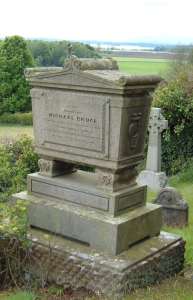 Kinnesswood is home to the famous Michael Bruce Way, a delightful walk, and boasts a 9 hole golf course and some lovely buildings dating from the 18th and 19th centuries. The Gentle Poet of Lochleven, Michael Bruce, whose grave can be seen in the Churchyard, was born here on 27 March 1746. He penned many poems, ballads and songs and died at the young age of 21 on 5th July 1767.The Michael Bruce Trust was created in 1905 for the purpose of raising funds to maintain the cottage where he was born. A year later, in 1906 the Cottage Museum was opened to the public. Keys to the museum can be obtained from the garage in the Main Street, an honesty box within the museum is provided for donations.
The main pockets of population in Portmoak are in Scotlandwell and Kinnesswood, where there is a primary school. The nearest libraries are in Leslie and Kinross but the village is visited by a mobile library every two weeks.
Kinnesswood in Bloom have produced an interesting leaflet entitled A Walk Around Kinnesswood.
Information about Kinnesswood and the Community Council can be found at the website www.portmoak.co.uk
“Head of the promontory”, from the Scottish Gaelic words Ceann “head” and ros “promontory”. Kinross is built on a promontory protruding into Loch Leven. The name was recorded as Kynros in 1144.Kinross the County town of Kinross-shire maintains a rural market town feeling despite the M90 motorway running alongside. It is difficult to imagine that Edinburgh and Glasgow, with all the traffic, hustle and bustle, are so close.
In the centre of the town can be seen the steeple which has rather an odd history. A church was designed in 1742 without a steeple. A committee was formed to raise money to provide one, the general feeling being that a church was not a church without a steeple. The money was, eventually raised, the steeple built and then the church was moved, leaving the steeple behind.
During the last century Kinross was on the main coaching road between Perth and Edinburgh and retains reminders of those days with the Muirs Inn and the Green Hotel, both well known coaching hostelries. Opposite the Green Hotel is the Market Park.
Kinross House, another interesting building with a history, was built in 1585-90 by Sir William Bruce. The house was, until recently, inhabited by the Montgomery family. The house and magnificent gardens are not open to the public. Rachel House, the first Childrens Hospice to be built in Scotland, is situated in the old walled garden of Kinross House.
Due to a visit from a famous German writer and poet, Kinross and Loch Leven are well known in Germany. In 1858, Theodor Fontane spent a day here and found in the area the inspiration for his book “Wanderungen durch die Mark Brandenburg”.
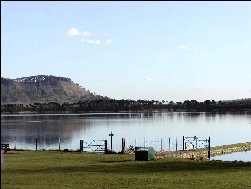 The peace and tranquility of Loch Leven is unusual in these days of water ski-ing, jet skis and motor boats. Paddle boarding, kayaking and trout fishing boats are allowed at certain times of the year.
The loch is the largest of its kind in lowland Britain and has been a National Nature Reserve since 1964. Nature Scot manages the reserve, which has been extended to include the RSPB Loch Leven (formerly Vane Farm) section run by the Royal Society for the Protection of Birds.
At Kirkgate Park, a short walk from the town centre, there is a play park for younger children and plenty of space for ball games, picnics or simply sitting to enjoy the views over to Benarty or the Ochil Hills.
The old Kirkgate Cemetery, at the end of the park, is well worth a visit. There are some very interesting grave stones as well as spectacular views over the loch to Castle Island and the Lomond Hills.
History of Loch Leven
The history of Loch Leven is rich and long. In 1335 Loch Leven castle was one of only 3 or 4 strongholds which had not fallen to the English. It was occupied by supporters of King David II (the son of Robert the Bruce) and was attacked by an army supported by the English monarch. The English force, aided by a number of Scottish Lairds (Lords) laid siege to the castle for nearly nine months without success. Frustrated, they attempted to flood out the occupants by blocking the Leven River and so increasing the water level of the loch. The plan backfired, however, when a group from the island broke down the dam during the night, the water surged out drowning many of the attackers who were camped on the river banks nearby.
The best known tale of the loch, though, is that of the tragic Mary Queen of Scots. Mary Stuart was born in 1542 and within a week of her birth her father, James V, died making her Queen of Scotland. Mary was brought up in France and in 1558 she was married to the Dauphin, Francis of France, who died two years later. Mary returned to Scotland and married Lord Darnley. It was not a happy marriage, he murdered David Rizzio her secretary and friend. A year later, he himself was murdered.
Mary, pregnant with James VI, proceeded to stage her own abduction so that she could marry the Earl of Bothwell who had been accused of murdering Darnley. The Scottish nobles were incensed, she was imprisoned here in the castle on Loch Leven and was forced to abdicate.
After eleven months one of the young pages fell in love with Mary, stole the keys and rowed her across to the shore where sympathetic nobles were waiting for her. It is still believed that the keys to the castle lie at the bottom of the loch where they were thrown. Mary was hidden by supporters while she gathered an army to fight to regain the throne but she was defeated at the Battle of Langside in 1568. With nowhere else to go, Mary fled to England seeking support from her cousin Queen Elizabeth I. Unfortunately Queen Elizabeth saw Mary as a threat to her own throne and imprisoned her. Mary spent the last twenty years of her life in prison before being executed at Fotheringay in 1587.
Situated on the A91, the main Stirling to St. Andrews road, Milnathort is an attractively maintained small town with a long history. It was developed as a market town and as a community of wool and linen weavers; flax was widely grown in the County until the 1st World War, and in 1880 there were 129 weavers in the Parish of Orwell which includes Milnathort.
The now ruined Burleigh Castle, built in the 15th century stands just outside the town on the A911 and a little further along the same road can be seen the Standing Stones of Orwell, two large whinstones which stand proudly in a field at the side of the road.
A gentle walk around Milnathort gives the visitor a feeling for the history of the town.
The 9 hole golf course has lovely views over Loch Leven and the Lomond hills.
Milnathort – What is in a name?
“Milsie” or “Millaforth”, as it is affectionately called by older inhabitants, may have been originally “Meall-na-Thorrceidh” or Hill of the Burial; alternatively, Mr David Beveridge (1888) suggests “Muilean-a-Thairt”, meaning Mill on the Further Side .. of a rivulet; the third suggestion is “Mills Furth”, meaning the Mills beyond the Palace of Falkland, eight miles away in Fife. These mills may have supplied meal and flour to the Stewart monarchs and their large entourages, when they came to hunt in the forests around Falkland.
Written by Mrs Nan Walker and published by Kinross-shire Historical Society in 1980
Burleigh Castle
This is one of seven Tower-houses or Keeps in Kinross-shire, the others being Lochleven, Arnot, Dowhill, Cleish, Aldie and Tullibole. Each castle is said to be within sight of at least one other so that beacon warnings of approaching enemies could be passed quickly round the county.
Burleigh Castle was built in the 15th Century; all that remains is an old four storey tower joined by a curtain wall to a smaller round tower which was the gate-house, added in 1582. In the curtain wall are an archway and several gun-loops. The whole building was once surrounded by a moat. (It is said to be haunted by the ghost of Grey Maggie).
The Balfour family, Barons of Burleigh, who held positions in the royal household for many years, owned the surrounding lands from 1456, but they were forfeited to the Crown in 1571 by Balfour of Pittendreich, and again after the Jacobite Rebellion in 1715.
Robert, the 5th Lord Balfour, had a wild and tragic career. While still the young Master of Burleigh, he was sent abroad by his parents to forget a love affair with a local maiden; on his return he found her married to the schoolmaster of Inverkeithing whom he killed in a fit of jealousy. He was sentenced to prison at the High Court in Edinburgh but soon escaped by exchanging clothes with his sister. For some time he hid in an old tree near the castle (called Burleigh’s hole) until he escaped to the Continent. He returned to take part in the ill-fated rising of 1715 and died leaving no heirs.
The title was in abeyance for 100 years and the castle fell into ruins. In 1868 Mr Alexander Bruce of Kennet, Clackmannanshire, was allowed to revive the title of Lord Balfour of Burleigh, and subsequently held office as Lord in Waiting to Queen Victoria, and Secretary of State for Scotland 1895-1903.
The castle is open to the public from 1st April – 30th September, 09.30 – 18.00hrs
Key available from 2, Burleigh Castle Steading, Milnathort, KY13 9GG, Telephone 01577 863226
The Standing Stones of Orwell
Drive from Milnathort towards Balgedie on the A911 and you pass, on your left, the Standing Stones. These two Orwell Standing Stoneshuge whinstones on a low hillock in the middle of a field are typical of the many monoliths found in Scotland, dating back to pre-historic times. In 1972 the west stone fell down, and while it was being re-erected experts examined the ground and found four cremation deposits, two of them in a two-tier burial, which is unusual. Carbon dating of bones from these deposits suggested they had been there since about 2000 B.C.
Half a mile beyond the stones can be seen, on the left, one of the last water wheels in Kinross-shire. This wheel served Powmill, once a fine example of our 18th century corn mills. It was a thirlage mill dated 1788, with a pantile roof.
Written by Mrs Nan Walker and published by Kinross-shire Historical Society in 1980 (The Kinross Museum has Mrs Walker’s books for sale)
 The tiny village of Rumbling Bridge, 7 miles from Kinross and the M90, on the A977 is well known for the very unusual double bridge over the River Devon. The lower bridge which is 80ft above the river bed was built in 1713. In 1816 another, parapetless, bridge was built over the first one at a height of 120 feet.
Spring water from the well, from which the village gets its name, was thought to cure many diseases. A hospital, established in 1250 by the Red Friars, became a popular destination for pilgrims including Robert the Bruce who visited the village in search of a cure for leprosy.
The well was one of several in the area, referred to in old documents as “Fontes Scotiae” or the “Wells of Scotland” As long ago as 84 AD, Roman soldiers marching between their camps at Lochore in Fife and Ardoch in Perthshire may well have stopped to take the waters and rested there.
The canopy over the well was built in 1858.
The village is home to the Portmoak Airfield, home of the Scottish Gliding Union.
The famous Poet of Loch Leven, Michael Bruce is buried in the tranquil churchyard at Portmoak Church.
